Headlines Team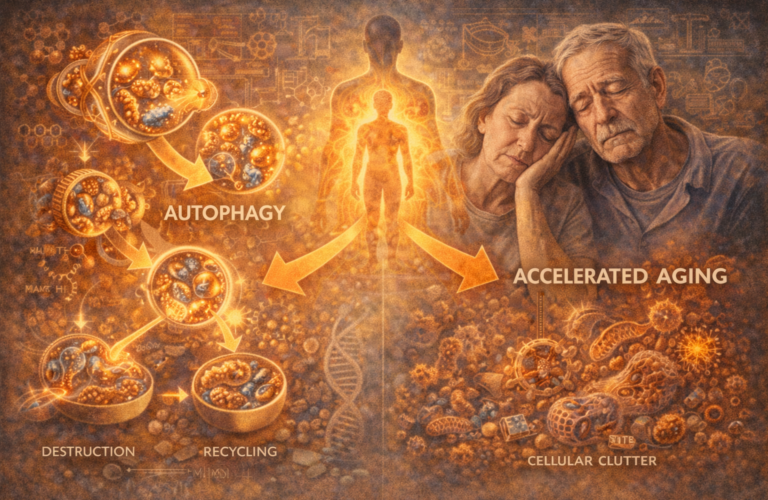
Aging is often described in visible terms. Wrinkles, reduced muscle mass, slower recovery, and cognitive decline are treated as surface markers of getting older. Beneath these outward changes, however, aging unfolds at the cellular level through processes that determine how well cells repair, recycle, and adapt. One of the most important of these processes is autophagy.
Autophagy, derived from Greek words meaning “self-eating,” is the cell’s internal recycling system. It allows damaged proteins, dysfunctional organelles, and metabolic waste to be broken down and reused. This process is essential for cellular efficiency and survival. As research has expanded, scientists have increasingly linked autophagy and aging, identifying declining autophagic activity as a key driver of accelerated biological aging rather than a passive consequence of time.
Understanding how and why autophagy declines sheds light on why aging accelerates under certain conditions and how lifestyle patterns influence longevity at a cellular level.
What Autophagy Does in Healthy Cells
Autophagy is a continuous quality-control process. Cells constantly generate waste through normal metabolism. Proteins misfold, mitochondria become damaged, and byproducts accumulate. Autophagy identifies these components, isolates them, and breaks them down into reusable building blocks.
This recycling supports energy efficiency, reduces oxidative stress, and preserves cellular function. In younger organisms, autophagy operates efficiently, preventing the accumulation of cellular debris and maintaining metabolic flexibility.
Autophagy also plays a protective role during stress. When nutrients are scarce, autophagy provides internal fuel, allowing cells to survive temporary shortages without damage. This dual role in maintenance and adaptation makes autophagy central to cellular resilience.
The Age-Related Decline of Autophagy
As organisms age, autophagic activity declines. This reduction is not abrupt but gradual, often beginning in mid-adulthood. Cells become less efficient at identifying and removing damaged components, leading to accumulation of dysfunctional proteins and organelles.
Research summarized by the National Institutes of Health has shown that reduced autophagy is associated with increased oxidative stress, mitochondrial dysfunction, and impaired cellular signaling.
These changes create a cellular environment where damage accumulates faster than it can be repaired. Over time, this imbalance accelerates tissue dysfunction and contributes to age-related disease.
Importantly, declining autophagy is not merely a marker of aging. Experimental models show that artificially suppressing autophagy accelerates aging, while enhancing autophagic pathways can extend lifespan in multiple organisms.
Cellular Clutter and Functional Decline
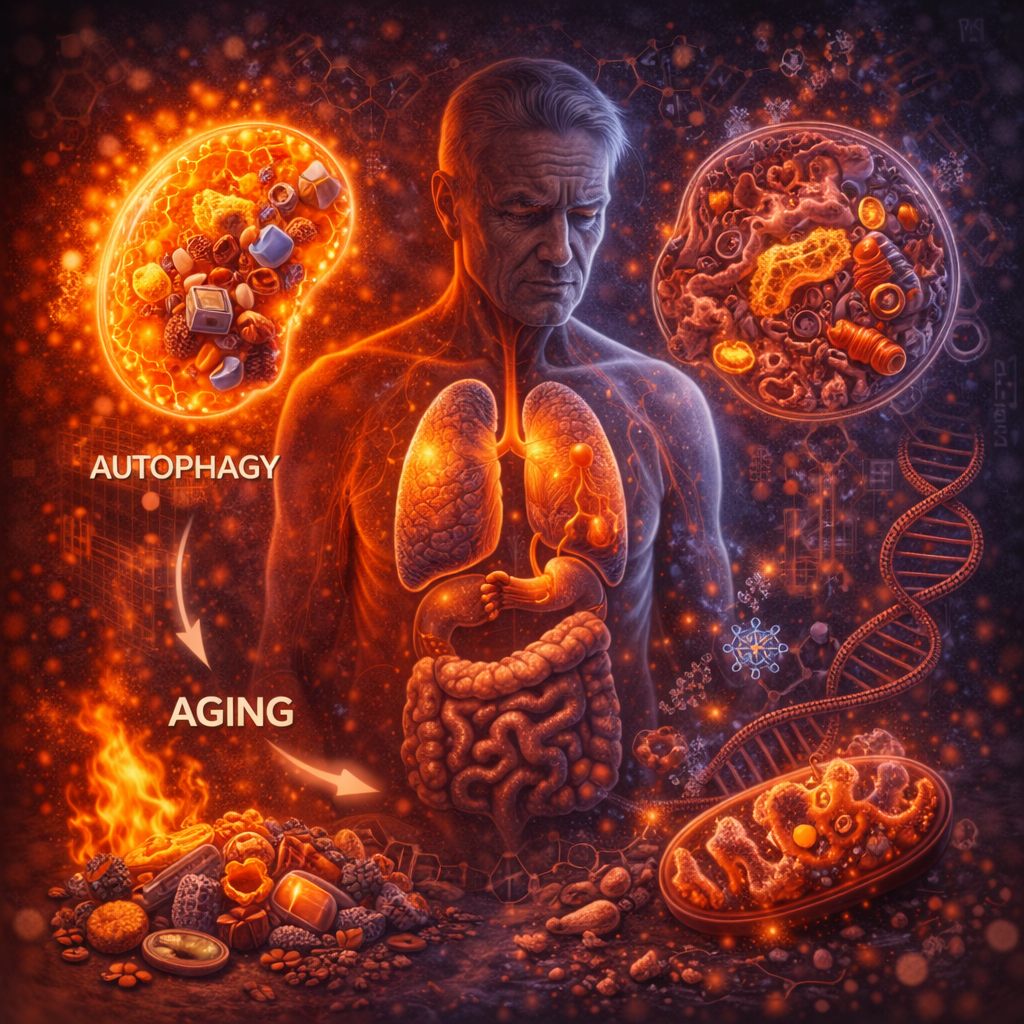
One of the most direct consequences of reduced autophagy is the buildup of cellular clutter. Damaged proteins interfere with normal enzymatic activity. Dysfunctional mitochondria produce less energy and more reactive oxygen species. Cellular signaling becomes less precise.
This clutter reduces cellular efficiency. Energy production declines, stress tolerance weakens, and repair mechanisms slow. At the tissue level, this manifests as muscle weakness, reduced cognitive endurance, and slower recovery from injury.
The link between autophagy and aging becomes especially apparent in high-demand tissues such as muscle, brain, and liver, where efficient turnover is essential for function.
Autophagy and Mitochondrial Health
Mitochondria are both a major source of cellular energy and a significant source of cellular stress when damaged. Autophagy plays a critical role in mitochondrial quality control through a specialized process known as mitophagy.
When mitophagy declines, damaged mitochondria persist. These mitochondria generate less ATP and more oxidative byproducts, creating a feedback loop that accelerates cellular aging.
Studies published in journals such as Nature Reviews Molecular Cell Biology have emphasized that impaired mitophagy is a central feature of aging and age-related disease.
This mitochondrial connection helps explain why declining autophagy is associated with fatigue, metabolic slowdown, and reduced stress resilience.
Inflammation and Autophagy Suppression
Chronic low-grade inflammation, common in aging populations, further suppresses autophagy. Inflammatory signaling interferes with cellular repair pathways, prioritizing immune activation over maintenance.
At the same time, reduced autophagy worsens inflammation by allowing damaged cellular components to accumulate. These components can trigger immune responses, creating a cycle where inflammation and autophagy decline reinforce one another.
This interaction highlights why aging is often accompanied by persistent inflammation and why autophagy is increasingly viewed as an anti-inflammatory regulator rather than a purely metabolic process.
Lifestyle Factors That Influence Autophagy
Autophagy is highly sensitive to environmental and lifestyle inputs. Constant nutrient availability, particularly from refined carbohydrates, suppresses autophagic signaling. Cells interpret continuous feeding as a signal that recycling is unnecessary.
In contrast, periods of low nutrient availability stimulate autophagy. This evolutionary adaptation allowed organisms to survive intermittent food scarcity by recycling internal resources.
Sedentary behavior also reduces autophagic activity. Physical activity stimulates cellular stress responses that promote autophagy, particularly in muscle and metabolic tissues. Sleep disruption and chronic stress further impair autophagic efficiency by altering hormonal signaling.
These factors help explain why lifestyle patterns strongly influence how quickly autophagy declines with age.
Autophagy, Aging, and Disease Risk
Reduced autophagy has been linked to numerous age-related diseases. Neurodegenerative conditions involve the accumulation of misfolded proteins. Metabolic diseases involve mitochondrial dysfunction and lipid accumulation. Cardiovascular disease involves impaired cellular repair within vascular tissues.
In each case, autophagy decline contributes to disease progression by allowing damage to persist rather than be resolved. This connection has shifted research focus from treating symptoms to supporting cellular maintenance systems.
Harvard Health Publishing has noted that cellular repair mechanisms, including autophagy, are increasingly recognized as central to healthy aging rather than secondary considerations.
Autophagy as a Longevity Marker
Longevity research increasingly treats autophagy as a marker of biological age rather than chronological age. Individuals with preserved autophagic function tend to show better metabolic health, cognitive resilience, and physical capacity.
Animal studies consistently demonstrate lifespan extension when autophagic pathways are enhanced. While human data is more complex, population studies suggest that behaviors associated with autophagy support correlate with improved healthspan.
Educational resources centered on metabolic health and longevity, such as those from Dr. Berg, often present autophagy as a key process that connects metabolism, aging, and disease risk.
Why Autophagy Decline Accelerates Aging
Aging accelerates when repair mechanisms fall behind damage accumulation. Autophagy sits at the center of this balance. When it functions well, damage is cleared and recycled. When it declines, cellular integrity erodes.
This erosion is cumulative. Each generation of cells inherits slightly more damage than the last. Over time, this accumulation manifests as functional decline across tissues and systems.
Understanding autophagy and aging through this lens reframes aging not as an inevitable decay, but as a process shaped by the efficiency of cellular maintenance.
Rethinking Longevity Through Cellular Maintenance
Traditional approaches to longevity have focused on treating diseases as they appear. Autophagy research suggests a different strategy: preserving the systems that prevent damage accumulation in the first place.
This does not imply stopping aging, but it does suggest that the pace of aging is modifiable. Supporting cellular cleanup processes may slow the transition from health to dysfunction.
This perspective aligns with a broader shift in longevity science toward maintaining cellular quality rather than targeting isolated outcomes.
The connection between autophagy decline and accelerated aging highlights a central principle of longevity biology. Aging is not driven solely by time, but by the balance between damage and repair.
As autophagic efficiency declines, cellular clutter accumulates, metabolic efficiency drops, and tissues lose resilience. Understanding autophagy and aging provides a framework for explaining why aging accelerates under certain metabolic and lifestyle conditions.
As longevity research continues to evolve, autophagy is likely to remain a focal point. Its role as a cellular recycling system places it at the intersection of metabolism, inflammation, and aging. Preserving this process may not promise immortality, but it offers a pathway toward extending healthspan by maintaining the cellular systems that keep aging in check.